Problem:
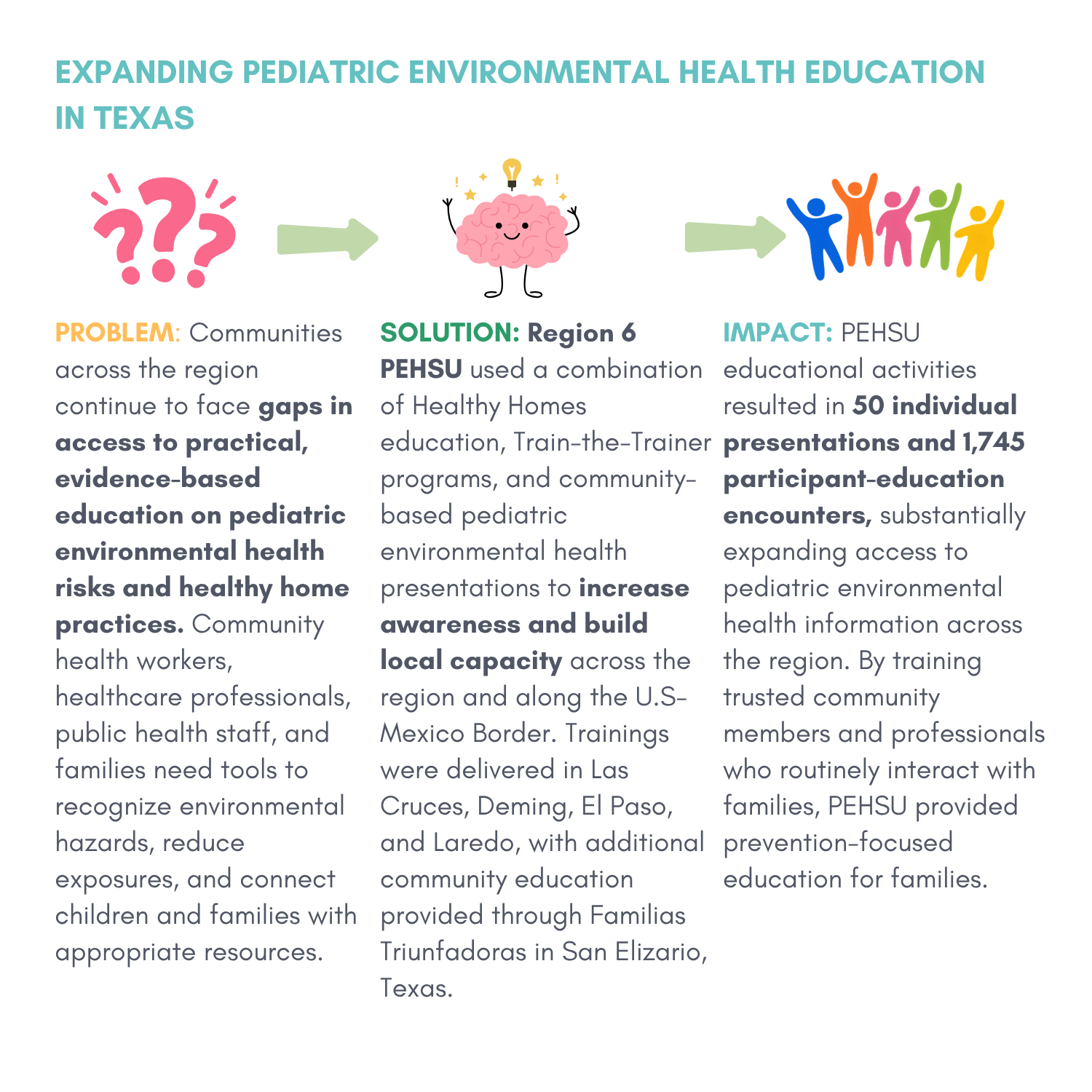
Communities across the region continue to face gaps in access to practical, evidence-based education on pediatric environmental health risks and healthy home practices. Community health workers, healthcare professionals, public health staff, and families need tools to recognize environmental hazards, reduce exposures, and connect children and families with appropriate resources.
Solution:
Region 6/Southwest PEHSU used a combination of Healthy Homes education, Train-the-Trainer programs, and community-based pediatric environmental health presentations to increase awareness and build local capacity across the region and along the U.S-Mexico Border. Trainings were delivered in Las Cruces, Deming, El Paso, and Laredo, with additional community education provided through Familias Triunfadoras in San Elizario, Texas.
Educational topics included Healthy Homes principles, pediatric environmental health, pesticides, lead, hazardous household chemicals, emergency preparedness, childhood cancer and environmental exposures, heat, tobacco and vaping exposures, and taking a pediatric environmental health history. A key component of the strategy was the use of bilingual educational flipbooks designed to make environmental health information practical, visually engaging, and easier to deliver in community settings. The flipbooks support both English- and Spanish-speaking audiences and provide CHWs, promotoras, and other community educators with a reusable resource for reinforcing key environmental health and prevention messages after the training. Activities were conducted in collaboration with community health workers and promotoras, healthcare and public health professionals, community-based organizations, and regional partners.
Impact:
PEHSU educational activities resulted in 50 individual presentations and 1,745 participant-education encounters, substantially expanding access to pediatric environmental health information across the region. Through Healthy Homes education, Train-the-Trainer programs, and community-based presentations, participants increased their exposure to practical information on recognizing environmental hazards, reducing harmful exposures, and protecting children and families. The bilingual flipbooks further strengthened this impact by providing CHWs, promotoras, healthcare professionals, and community educators with a practical resource they can continue using to reinforce environmental health messages beyond the initial training. By training trusted community members and professionals who routinely interact with families, PEHSU helped build local capacity to identify environmental health concerns earlier, provide prevention-focused education, and connect families with appropriate resources and expertise.