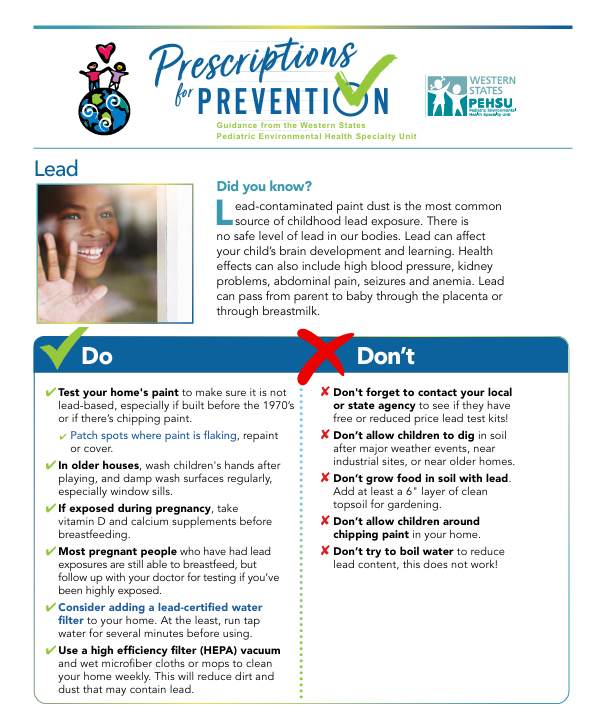



Lead (for Health Professionals)
Lead is a neurotoxicant that adversely affects neurodevelopment even at low exposure levels. Adverse outcomes associated with prenatal or early life exposure include ADHD, delayed learning and growth, lower IQ, developmental and behavioral problems, hypertension, hearing loss, renal dysfunction, and reproductive issues.
Children under 6 years of age have unique behaviors and physiology that increase their risk for exposure to lead and subsequent adverse developmental and health outcomes. Most children with elevated blood lead levels are asymptomatic or have nonspecific symptoms.
Blood lead testing is the best way to identify lead-exposed children. Evaluate for lead exposure risk factors at well-child visits from 6 months to 6 years and as early as possible in pregnant women and provide anticipatory guidance on exposure prevention. Perform blood lead testing in accordance with federal, local, and state requirements and recommendations. Recognition and timely interventions can reduce harm and improve outcomes for lead-exposed children and pregnant women. Health professionals play a key role in preventing exposure, identifying and treating lead poisoning in patients, and advocating for public health measures to address the problem.
The Good News: Lead poisoning is preventable.

0
The amount of lead associated with no adverse effects (1).
20%
The national average for blood lead testing in children under 6 years old in the U.S. in 2021 (2). children under six are most vulnerable to lead toxicity due to their unique physiology and behaviors
3.5 micrograms per deciliter (µg/dL)
CDC’s blood lead reference value (BLRV) “to identify children with blood lead levels that are higher than most children's levels.” (3).
Exposure—sources, signs & symptoms
How Are Children Exposed to Lead?
Children may be exposed to lead by ingesting peeling lead-based paint or lead contaminated dust or soil, from dishes or glasses that contain lead, eating and drinking food or water containing lead (i.e., imported spices, powders, or candies), or from playing with toys with lead paint.
What Are the Signs and Symptoms of Lead Poisoning?
A majority lead exposed children in the US will have no signs or symptoms of lead toxicity because most poisonings are subclinical (BLL < 45 μg/dL). These children will be asymptomatic at the time of exposure, with adverse effects only becoming evident as they grow older. Blood lead testing is the best way to identify lead exposed children and intervene to minimize risks for adverse outcomes. Clinically evident effects of acute toxicity typically occur around BLLs of 45 µg/dL and include anemia, abdominal pain, nephropathy, and encephalopathy. Children may present with nonspecific symptoms that progress with increasing blood lead levels. Symptoms may include headaches, abdominal pain, loss of appetite or constipation, signs of clumsiness, agitation, or decreased activity and drowsiness, vomiting, stupor, and convulsions. Subtle symptoms, such as anorexia or abdominal discomfort, may occur in some children starting around BLLs of 20μg/dL.
How Does Lead Cause Damage to Children?
Lead is a neurotoxicant that interferes with critical development processes in the central nervous system, potentially irreversibly damaging the developing brain. Any detectable blood lead levels are associated with adverse effects on IQ and other neurodevelopmental outcomes Lead alters basic nervous system functions, like calcium-modulated signaling, at very low concentrations in vitro. Lead levels often peak at the age of 2 years, the same age at which a major reduction in dendrite connections occurs, among other events crucial to development. It’s possible that lead exposure at that time interferes with a critical development process in the CNS, but what that specific process is has not been clearly identified.
Lead has important non-neurodevelopmental effects. The kidneys are common targets, and children exposed to lead are at significantly greater risk of becoming hypertensive as adults. Lead interferes with the body’s ability to use vital nutrients vitamin D and iron. Exposure has been linked to delayed growth. High exposure levels (BLLs greater than 40 µg/dL) may result in anemia, nephropathy, and encephalopathy, with potentially fatal seizures and cerebral edema at levels over 100 µg/dL. Health effects from early life exposure may not be clinically evident until later in life. Examples of latent adverse outcomes include ADHD, delayed learning and growth, lower IQ, developmental and behavioral problems, hypertension, hearing loss, and reproductive problems.
What Anticipatory Guidance Can I Provide Families on Preventing Lead Exposures?
Here are some general steps to reduce lead exposure from common sources you may share with families.
- Test your home for lead. If the family’s home was built before 1978—especially before 1960—encourage them to have it tested for lead hazards. If they don’t know how old their home is, assume there is lead. Some state and local health departments have resources for families on how to test for lead. You may also refer them to EPA’s Lead-based Paint Professional Locator to find a certified lead inspector in their area.
- Renovate Right. If they live in an older home with known or suspected lead-based paint, educate families on safe ways to make repairs. Home repairs and renovations can create dust and debris that have lead, which is a common source of exposure in pregnant women and children. Stress the importance of using a lead-safe certified contractor or closely following guidelines in the EPA’s Lead Renovation, Repair, and Painting webpage if doing the work themselves. If work is not done safely, harmful exposures can occur.
- Keep your children away from chipping or peeling paint, especially near windowsills, doorways, trim, and porches. Children may ingest paint chips or dust on purpose or by accident, which can lead to acute lead poisoning. Advise families to cover peeling paint with contact paper or keep children away until it can be safely removed. If they rent, advise them to notify their landlord of the need for lead-safe repairs. Landlords are legally required to repair lead problems in properties occupied by children.
- Stay safe from lead in soil. Lead from chipping lead paint from buildings is the most common source of lead in soil. Advise families on steps to keep outside dirt from getting inside. These may include:
- Planting grass or applying mulch or wood chips to cover bare soil in their yard.
- Using doormats at entryways.
- Not wearing shoes inside.
- Wiping pets’ paws before they enter the house.
- Take care not to bring soil on clothes, shoes, or tools inside after gardening. Have children wear gloves to garden and wash their hands afterward. The soil in some areas may be contaminated with lead from past land uses (e.g., mining, industrial release, improper waste disposal, shooting range). Clinicians can direct families to local public health or environmental departments if this is a concern in their community.
- Clean regularly to remove dust and dirt inside. Educate on the importance of keeping the places where the child spends time free of dirt and dust. Advise families to
- Wipe down floors and other hard surfaces with a damp mop or sponge to trap dust and dirt. Use a vacuum cleaner with a HEPA filter for carpets.
- Wash toys, blankets, and other objects the child puts in their mouth regularly.
- Help with handwashing. Washing with soap and water removes lead from hands. Hand sanitizer kills germs but does not remove lead. Advise families to wash their infant or young child’s hands frequently, especially after playing outside and before eating or napping. Encourage families to teach proper handwashing techniques and supervise older children.
- Leave lead at work. If a household member’s work or hobbies involve lead, provide education on how to prevent take-home exposures. Advise the household member to change clothes and shoes before entering the home, keep their clothes at work or wash them as soon as possible, Wash all work clothes separately, and shower soon after returning home before playing with children.
- Use only cold tap water to mix formula, drink, or cook. Lead can be in water due to lead pipes, solder, or old faucets. If possible, encourage families to test the water from the faucet they use for cooking and drinking. Direct them to EPA’s website Protect Your Tap for information on how to test their water for lead. If they have lead in their water, or if they have concerns but are unable to test, encourage using a water filter (sink or pitcher) labeled as “NSF certified” to remove lead.
- Eat healthy. Provide nutritional counseling on a well-balanced diet that includes a variety of foods that are high in calcium and iron. Educate them that kids with low iron levels are more likely to have higher blood lead levels. Advise them that foods with vitamin C, iron, and calcium may help keep lead out of the body. Click here for a printable factsheet you may share with families on a healthy diet to fight lead.
- Avoid certain children’s products and toys. Some toys, especially imported toys, antique toys, and toy jewelry, may contain lead. Advise parents to use caution when buying toys from discount or secondhand stores, as these may be more likely to contain lead. Advise parents to visit the Consumer Product Safety Commission’s (CPSC) web page for photos and descriptions of currently recalled products: https://www.cpsc.gov/Recalls. Search by selecting “lead” in the hazard search box.
- Avoid using imported food, spices, cosmetics, or traditional medicines that may contain lead. Lead has been found in spices, supplements, foods, Ayurvedic, and other traditional medicines imported from certain countries. Encourage families to use caution with spices, cosmetics, and foods imported or purchased in another country. Encourage them to choose trusted brands based in countries with stricter lead regulations, such as the US or Canada. Encourage families to choose supplements or products that are third-party tested for lead or call companies to ask if they test for lead. Provide education on the potential for lead in certain traditional medicines or folk remedies. Click here to learn more about products from specific countries or cultural products that have been found to contain lead. https://www.cdc.gov/lead-prevention/prevention/foods-cosmetics-medicines.html
Testing
What are the Current Blood Lead Testing Recommendations and Requirements for Children?
Required testing in children: Healthcare providers in every state must test all children enrolled in Medicaid for lead at 12 and 24 months. Children must also be tested if they are 24–72 months old and have no record of being tested. For children not enrolled in Medicaid, requirements for blood lead testing vary by state. Some states also have universal or targeted lead testing requirements for children not enrolled in Medicaid. For example, New Jersey requires universal blood lead testing of all children at 1 and 2 years of age or as soon as possible before age 6 with no record of being tested. Ohio requires blood lead testing in all children under 6 years who meet specific risk screening criteria. Clinicians can contact their local or state health department to determine lead testing and reporting requirements in their area.
Recommended testing in children: In addition to Medicaid-required testing, CDC recommends blood lead testing for all children at increased risk for lead exposure. Examples include children who live or spend time in a house or building built before 1978, children from low-income households, children who are immigrants, refugees, or adopted from another country, children who have developmental or behavioral disorders involving pica or mouthing behaviors, and children who are malnourished or iron-deficient.
What Testing is Recommended for Pregnant and Breastfeeding Women?
Maternal lead passes easily across the placenta to the developing fetus. Blood lead levels are associated with adverse maternal and fetal health outcomes. Prenatal lead exposure affects children’s neurodevelopment, placing them at increased risk for developmental delay, reduced IQ, and behavioral problems. Lead is excreted in breast milk and may be a significant source of exposure for some breastfeeding infants. CDC and the American College of Obstetricians and Gynecologists recommend evaluating all pregnant and breastfeeding women for risk for lead exposure and performing blood lead testing if risks are identified (see Additional Resources section).
What are Tips for Talking to Families about Blood Lead Levels Results?
Any detectable blood lead levels, even below 3.5 µg/dL, are associated with subclinical effects such as inattention, hyperactivity, and decreased cognitive function on a population level. Health Care professionals can provide education that even low blood lead levels are associated with developmental delays, difficulty learning, and behavioral issues. However, a blood lead level does not mean a child will develop these conditions. The evidence for harmful effects is based on data drawn from populations of exposed children and is not intended to be interpreted at the level of the individual child. It may be helpful to explain to families that while children with blood lead levels are more likely to experience certain health effects, it does not necessarily mean that their child will. Explain to the family that the potential health outcomes are multifactorial or impacted by many factors. Reassure parents that there is evidence for the positive impacts of proactive measures for promoting healthy brain development, such as providing a stimulating and safe environment, adequate sleep, early education, and good nutrition. You may also share that early educational interventions have been shown to reduce lead-related harm and provide referrals to services for children with BLLs above the CDC reference value, if available.
What if the BLL does not decline or is higher at follow-up testing?
If a child’s BLL value has not decreased or increased slightly (<4 μg/dL) within the recommended follow-up testing period, it could mean the child is still being exposed to lead. It could also reflect variability in laboratory testing or seasonal trends. Clinical Laboratory Improvements Amendments (CLIA) Proficiency testing criteria allow for a margin of error of ±4 µg/dL or ±10%, whichever is greater. BLLs also show seasonal variations, peaking in the summer months. If the BLL has gone up by greater than 4 μg/dL, it is likely the child is still being exposed to lead in their diet or environment. Reassess for potential lead exposure sources. If a likely source is identified, provide guidance on eliminating or reducing the child’s exposure and retest the child within the recommended time frame for their BLL. We recommend collaborating with the Childhood Lead Poisoning Prevention Program (CLPPP) in your area to help identify and mitigate the source of the exposure. Depending on the program’s case management protocol, they may be able to visit the home, do lead environmental lead testing, or offer other services. Contact your regional PEHSU to talk to a specialist if you have concerns about follow-up test results or need assistance identifying potential lead sources.
What are the Steps for Clinical Management of a Lead-Exposed Child?
There is no cure for lead poisoning. The primary and most crucial step in the clinical management of a lead-exposed child is to identify and eliminate the exposure. Public Health Departments can be valuable partners in identifying and mitigating or eliminating the source of exposure. However, clinicians should be aware of the most common exposure sources and be able to provide guidance to families on identifying and reducing potential exposures. The most common source of lead exposure in the United States is lead-based paint from structures built before 1978. Other sources can be more challenging to identify. They may include (but are not limited to) soil, imported cookware, water, nutritional supplements, folk or traditional medicines, imported food (including spices), cosmetics, toys and children’s jewelry, ceramic dishware, and cultural/religious powders. Household members may bring lead into the home from hobby or workplace exposures. Additional testing and clinical interventions are dependent on the BLL. In cases where the child is symptomatic and/or the BLL ≥ 45 μg/dL, chelation therapy may be necessary. Acutely symptomatic children should be treated as medical emergencies.
Pregnancy & lactation
What Are Some Steps for Managing Lead Exposure During Pregnancy?
Lead readily crosses the placenta by passive diffusion. Cord blood lead levels are strongly correlated to maternal blood lead levels, with cord BLL being, on average, 0.80 times that of maternal BLL. Prenatal and early childhood lead exposure are associated with decreased IQ, learning and behavior problems, and reduced growth. Elevated maternal BLLs are associated with an increased risk for gestational hypertension, spontaneous abortion, and preterm delivery. The most critical step in clinical management is identifying and eliminating any ongoing exposure source. Potential exposure sources may differ in pregnant women compared to young children. Examples of possible sources include hobbies, workplace exposures, pregnancy-related pica, lead paint dust from renovations, traditional medicines, and endogenous bone lead stores from past exposures. During pregnancy, the mobilization of bone lead increases as the bone is resorbed to produce the fetal skeleton. Because of this, an elevation in BLL may occur without any recent or ongoing exposures. Based on the maternal BLL, medical management may include nutrition counseling, calcium supplementation, referral to services, and additional testing. Pregnant women with BLLs ≥45 μg/dL should be treated as a high-risk pregnancy with consultation from an expert in lead poisoning and chelation. Clinicians should also provide a referral to a maternal-fetal medicine specialist.
At What Maternal BLL Should Pausing Breastfeeding be Considered?
Maternal lead can be passed through breast milk to the baby. The benefits of breastfeeding likely outweigh the risks from potential exposure based on the current state of evidence. Lead cannot be removed from breast milk, but calcium supplementation (1,200 mg daily) has been associated with a 5–10% decrease in breast milk lead levels among individuals over the course of lactation. Encourage the initiation of breastfeeding at maternal BLL ≥ 40 μg/dL; however, the following steps should be taken:
- Evaluate potential lead exposure sources for both the lactating person and the infant. Provide guidance on eliminating additional lead sources and preventing further exposures.
- Prescribe calcium supplementation of 1,200 mg/daily.
- Monitor the infant with serial BLLs. Encourage the continuation of breastfeeding without interruption unless all the following are true:
- The infant’s BLL is ≥5 μg/dL.
- Maternal BLL is ≥20 μg/dL, and the infant’s BLL rises or fails to decline.
- A comprehensive evaluation of the infant’s diet and environment fails to identify any potential lead exposure sources other than breast milk.
Maternal BLL of ≥ 40μg/dL may result in more significant exposures to the infant, and it may be advisable to pump and discard breast milk until maternal BLL has decreased to less than 40 micrograms/dL. We recommend consulting with a PEHSU specialist or a clinician experienced in treating lead toxicity in lactating individuals before advising interruption of breastfeeding based on blood lead levels.
References:
- United States, Department of Health and Human Services, Centers for Disease Control and Prevention. “About Childhood Lead Poisoning Prevention.” Centers for Disease Control and Prevention, 17 March 2025, https://www.cdc.gov/lead-prevention/about/?CDC_AAref_Val=https://www.cdc.gov/nceh/lead/acclpp/final_document_030712.pdf
- Hauptman M, Niles JK, Gudin J, Kaufman HW. Individual- and Community-Level Factors Associated With Detectable and Elevated Blood Lead Levels in US Children: Results From a National Clinical Laboratory. JAMA Pediatr. 2021;175(12):1252–1260. doi:10.1001/jamapediatrics.2021.3518
- United States, Department of Health and Human Services, Centers for Disease Control and Prevention. ” About the Data: Blood Lead Surveillance.” Centers for Disease Control and Prevention, 17y March 2025, https://www.cdc.gov/lead-prevention/php/data/blood-lead-surveillance.html.
Contact your regional PEHSU to speak with a specialist if you have questions not addressed by the FAQs or would like guidance managing care for a lead-exposed child or pregnant or breastfeeding woman.
No matching results.
The PEHSU Newsletter
Receive periodic program updates and get the latest research and insights from our environmental health experts on reproductive and pediatric health.