
Featuring Dr. Mark Anderson
What role does the environment have on childhood asthma? Is lead found in rural areas or just urban areas?
Mark Anderson, MD, FAAP, discusses childhood, asthma, lead, and community partnership in this episode of Pediatric Environmental Health Radio. Dr. Anderson is a retired pediatrician from Denver Health in Denver, Colorado and a former associate professor of pediatrics and public health at the University of Colorado. Dr Anderson specializes in issues relevant to children’s environmental health, such as asthma, water quality and soil quality. He also serves as the outgoing Director of the Pediatric Environmental Health specialty unit (PEHSU) for Region 8 covering the states of Colorado, Montana, North and South Dakota, Utah, and Wyoming.
Listen Here
Play the podcast in the web player below.

It’s also available on Spotify and iTunes. View the transcript at bottom of the page.
Resources
CDC/ASTDR Resources
Read More from Dr. Mark Anderson
- Home visits for pediatric asthma – A strategy for comprehensive asthma management through prevention and reduction of environmental asthma triggers in the home.
- Bureaucratic Barriers to Clean Environment for Native Americans Don’t Hold Water
- Successful school-based intervention for inner-city children with persistent asthma.
Transcript
Whitney Sterten-Hall: All right, today I’m talking to PEHSU expert and pediatrician, Dr. Dr. Mark Anderson Anderson. What is your current role with PEHSU? How long have you been involved and what brought you to PEHSU in the first place?
Dr. Mark Anderson: Hello. I originally got involved with the PEHSUs in the late 90s, so it must have been 1998, so that’s going on, what, 30 years? A couple years ago, I retired from clinical pediatrics practice and administrative practice and now just doing this grant program. And the reason for that was to transition it to a new person who has come online and will be taking over fully.
Whitney Sterten-Hall: That’s great. I guess I’m curious, how did you hear about PEHSU too? You’ve been with PEHSU so long.
Dr. Mark Anderson: The PEHSUs were really new at the time that I first heard about them. There was a conference that was held in Phoenix and I was invited by my institution to attend on the behalf of the Colorado chapter of the American Academy of Pediatrics. I had no idea what the conference was about, why it was going, but when I got there, I’m looking back on it, certainly all the big names were there.
And that was, I think, a grant that was to get the Children’s Environmental Health Movement going in the United States. So 1998, Phoenix. And that was the weekend I started hearing about the PEHSU and I was writing the grant at that point that was eventually awarded.
So somewhat by accident, I discovered it. My interest was in other stuff, namely asthma and fixing what I view as a broken healthcare system. So I was looking for some specific things to do, which I’ve been able to do over the last two and a half decades.
But the PEHSU and finding it and getting involved with it was really quite an accident. Great. Yeah, it’s so cool that you’ve been involved since the beginning when it started.
Whitney Sterten-Hall: You got into this a little bit, mentioning asthma, but before we get into more of the weeds about PEHSU, what sparked your initial interest in environmental health and pediatrics?
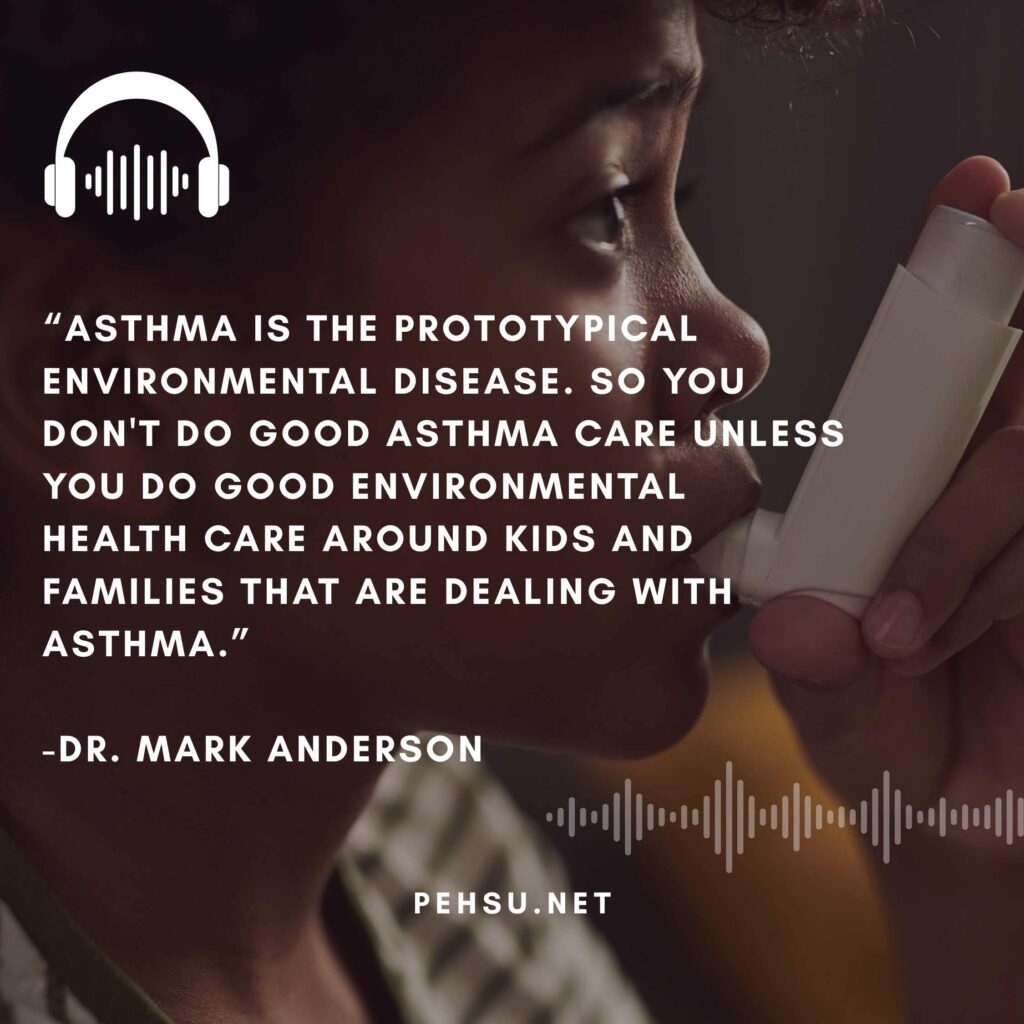
Dr. Mark Anderson: Well, asthma is the prototypical environmental disease. So you don’t do good asthma care unless you do good environmental health care around kids and families that are dealing with asthma. So the marriage is an obvious one. There were a limited number of items that were to be included in the initial grant when you applied and asthma was one of the named entities. So it seemed like a good fit in that regard. So it looks like a lot of your work on asthma and their air qualities has continued over several years.
Whitney Sterten-Hall: Can you talk a little bit about how it’s changed or programs that are still going? I mean, I’m thinking especially of the home visits for pediatric asthma. And is it mainly in Colorado that you focus on that work?
Dr. Mark Anderson: My focus is in Colorado, but that’s only because of where the program is located. There are many examples of high quality programs across the United States.
And one of those articles was written in cooperation with the people from Mount Sinai who are trying to do similar work. My theory is that we work in and we get cared for by a dysfunctional health care system. And unless we can think of different models and ways to improve care, the system will continue to be dysfunctional, not to mention expensive and have poor quality outcomes.
So it’s through a quality improvement lens that the asthma home visit program was first envisioned and through which it’s been conducted. COVID got in the way a little bit, actually not a little bit, a lot of it, with the home visit program as it was. So we developed this virtual format, doing pretty much the same stuff.
But if a parent or a kid can hold a cell phone and walk you through a home, you can do a pretty basic inspection of where they’re living. You’re still taking someone who has some expertise in asthma care out to a family or out to a kid, which I think circumvents a lot of the barriers that people experience in getting into a doctor’s office. And again, the idea is to improve care and through that improve the quality of life of the kids that we touch with.
Whitney Sterten-Hall: Great, thank you. I know you’ve worked on school-based interventions as well in this area. Do you want to talk about that at all?
Dr. Mark Anderson: There’s one program that it’s a bit old now, and I frankly don’t know if the school still exists, but in Denver, National Jewish is located on one of the dirtiest, most polluted corners in the city.
But they had at least a school called the Koonsburg School, and kids with pretty severe asthma would go to school there. And again, quality improvement, circumventing health care issues, trying to get families and kids into a school where there really is some good expertise, i.e. nurses who are supervised by a team, of course, or they work with a team who are very good, they’re very adroit at addressing daily issues with asthma. One of the key interventions that the Koonsburg School did was they monitored therapy.
So kids would line up in the morning and they would get their inhaled steroid, and the nurse or the assistant would watch them take it. So it really was daily observed therapy for asthma care. And the study I did of it looked at utilization on the hospital side as a result of being enrolled in that school.
And no surprise, kids who are taking their controller medications tend to have better asthma control. Therefore, they don’t use the emergency department, they don’t get hospitalized as much as they do when they’re not taking their medicines. So it’s a neat intervention that deserves some study.
Not really practical, because that’s a very special school and special expertise was there, and the location was certainly very unique. But it does provide a model on how some things can be done. And I did try to take the program to a couple of the Denver Public Schools that were not at National Jewish, and over about six months working with a couple nurses, tried to establish an observed therapy program similar to what is seen in Koonsburg.
And I didn’t get much beyond the proof of concept stage because it was just so hard to do that work with just me, myself, and I.
Whitney Sterten-Hall: Yeah, I imagine that can turn into a mountain very easily. You’ve also worked with tribal communities in your region. And what are some key issues you’ve seen children face compared with kids in more urban communities? And what are some recommendations you have for health professionals who want to partner with tribal communities?
Dr. Mark Anderson: Region 8 is not unique in that it has several tribal communities. We have several. There’s only a couple in Colorado, but there are many in Montana, which is where I’ve focused. And I think anyone who cares for kids or is involved in kids’ health care should take the time to look around in their community and really see what’s out there.
So from pure curiosity, I think working with tribes or knowing about tribes that might be located near you is a good thing.
A couple people who had worked with tribes in Montana who I got the pleasure to work with. And we just designed some interventions, and mostly it was around air quality and water quality.
It turned out to be really fun, a great cultural experience for me personally. So that was another driver that I sort of discovered happenstance along the way. Other regions do similar work, I’m sure.
And I think it adds depth and breadth to professional experience by doing things like this.
Whitney Sterten-Hall: When I think of your region, I also think a lot about rural health. So you mentioned in Montana, especially in places like Montana or Wyoming or the Dakotas, how is working with rural populations different than say tribal communities? And what has worked well for you over the years in building partnerships with these harder to reach populations?
Dr. Mark Anderson: The challenges that the Region 8 PEHSU experiences are the same challenges that other PEHSUs undoubtedly experience.
And it didn’t take long for me to figure out that my EPA and ATSDR partners were suffering from the same sort of barriers and that were all located in Denver, which is the big city in Region 8. The Region 8 is a pretty big area. And getting reached, getting out to those areas is a challenge. So one was just getting the word out and who you try to do that through.
And programs I’ve found have come and gone over the years. So South Dakota may have a lead program and then the next year not have a lead program. So you establish these links and then they’re gone.
So maintaining contacts has been hard. Once you’re out there, though, you do start to get some calls and get some people reaching out to you. And then the challenge becomes one of resources.
So if you’re in Denver or even in Colorado and you have a kid who has an elevated lead level, the solution is pretty straightforward. But if there’s no one to go look at a home or talk to a family or do a kind of in-person environmental health interview, then you’re stuck. And it’s very challenging.
Whitney Sterten-Hall: There’s a follow-up question to that. Is lead an issue that you see in tribal and rural communities, too? Or is it mainly something you’ve seen in urban areas like Denver?
Dr. Mark Anderson: Yes. It is pretty much everywhere. So it may not be just the lead paint, which is the sort of issue, the traditional issue of older homes that have been painted and repainted with paint that may have had lead in it. But lead can appear really anywhere. And unless you’re looking for it, you won’t find it.
So even though we’ve been writing the story of lead for over 100 years in the United States, it seems like it’s an issue we’re still working on. It is certainly the most common issue that I get involved with and that the people I work with get calls about and are asked for help with. So very much around, understanding the local epidemiology of lead is important.
Denver, and I assume there’s other cities that are like this, the inner city of Denver is very much in demand. The real estate is expensive. People who have some wealth tend to be the ones that live in the inner city now, the beautiful old homes that were built in the 1880s and the 1900s.
And because their kids may not be covered by public insurance like Medicaid, the assumption is they don’t have lead exposure, but it’s exactly the opposite. And I use that over the years to argue just for universal screening. Who cares what the insurance is? If the kid’s in front of you, screen them for lead if it’s not been done or try to follow the guidelines about screening early.
So very much still around. If you don’t look for it, you don’t find it because at the levels that we’re typically dealing with, it’s silent. But it does have great issues for later life if it’s not picked up and dealt with.
Whitney Sterten-Hall: Thank you. Can you talk more about your work with soil over the years through Soil Shop? What is Soil Shop? I didn’t know about it until working on this program. And how has your region been involved in it?
Dr. Mark Anderson: So the ATSDR is couched within the CDC. And the CDC has this on the shelf program called Soil Shop. And deep in COVID, when we couldn’t talk to each other, couldn’t go do the usual public health things that we all are interested in doing. I heard about Soil Shop.
And with my partners, we got together. We designed what ended up being called a distanced soil shop, so a desoil shop. And we did an outdoor drive-through soil shop.
People brought in samples from their gardens. And when they scheduled their arrival, we kept them 10 minutes apart per car. When they scheduled their arrival, we told them exactly how to collect their samples.
And we did the analysis, which was just for lead in Soil Shop. And they did a drive-through soil shop. And it was an interesting experience.
And the programming is so easy that it actually got some roots. And the state of Colorado has done a couple. Being simply a consultant, Utah and Montana have both done soil shops in Region 8. We’ve done others where it’s in person.
And it’s a neat program because it’s packaged. All the materials you need to do a Soil Shop are available from the CDC. You just have to download them.
Communities tend to be interested. The shop itself is pretty simple. It’s just about lead in soil.
But you can make it much more interesting. You can create a health fair around a soil shop. You can do urban gardening.
You can do outdoors experiences for kids as part of a Soil Shop. Plus, the science of it is just as neat. You get to play with the XRF gun and look and see what’s really in the soil beyond lead.
Although we only talk about lead as part of Soil Shop. And there have been several of them that have happened in Region 8, mostly in Colorado. But in the wake of that original distance at Soil Shop, it got some roots and grew.
Whitney Sterten-Hall: That’s so cool about the drive-ins. The XRF gun, is that like that you scan the soil with something? Or is that how it works?
Dr. Mark Anderson: You take a sample and there’s ways to collect it. It needs to be handled in a certain way. But you just point this device at it, which we call the XRF gun, and X-ray fluorescence. And it tells you the entire constituents of the soil. So the toxin we’re interested in as part of Soil Shop is lead.
But you can still talk to people about their concerns, whether it be lead or stuff.
Whitney Sterten-Hall: Hmm, so cool. Thanks for sharing. Well, you have a lot of history with PEHSU.
You’ve been there since the beginning. What are a few standout lessons you’ve learned or key impactful moment you’ve had that comes to mind working on children’s environmental health? And if you want to share anything about how PEHSU has changed over time, you’re welcome to also.
Dr. Mark Anderson: I think technically I wasn’t there at the beginning, because Region 8 was the last region to come up into the PEHSU network. And there had been PEHSUs for at least a year or two that Kathy Kirkland through the AOEC was working to get going. Seattle was one of them. I think Boston was the other first PEHSU.
Meet people. I’ve always enjoyed talking to them and working with them. And projects not related to the PEHSU have spun off that have just been interesting because it’s such a talented group of people.
One of my early lessons, and this was based on a phone call that I got about Crumb Tire, Recycle Crumb Tire being used in the playground, which I don’t even know such thing existed. But this was back in the early aughts. It doesn’t matter what you’re getting a call about.
There is someone somewhere in the PEHSU network who’s going to know something about that issue. And that became very clear to me early on. It’s a matter of reaching out and asking for help and finding someone to talk to.
It’s an amazing network in that regard. There really is a vast expertise about many topics beyond the core ones that we talk about and deal with in the PEHSU network.
Whitney Sterten-Hall: Thanks. I didn’t ask this question either, but I’m curious since you’re retiring soon. Is there anything that you look back on with your time in PEHSU that you feel like really proud of? I mean, it seems like asthma stands out, but yeah, I’m just curious to hear what you think.
Dr. Mark Anderson: I think the thing that I’m proudest of, and this is not unique to Region 8, but really good partners, federal partners to work with.
And that has been largely maintained over the entire time that I’ve been working with the PEHSU network. Not everyone has that, but I think every PEHSU should almost by default, the requirement, you know, be working with their federal partners. For one, it helps address the regionality issue that I mentioned earlier, but it brings different perspective to what you’re doing.
So, you know, my ATSDR partner, Chris Poulet, he does things that, you know, I just wouldn’t see in a pediatrician’s office. And same comment about now Kim Bartles, the EPA Children’s Health Rep. They do things that we should know about and that we should be helping them with as much as we can.
But just having a good relationship with them has made the grant program so much more doable. It’s made it more enjoyable. It’s been a very positive part of my experience in the program.
Whitney Sterten-Hall: Nice. That’s great to hear. Well, this is a very broad question, but if you could give a caregiver a parent or a health care provider, community health worker, so you can choose any of those. One piece of advice about children’s health and the environment, what would that be?
Dr. Mark Anderson: Oh, gosh, one piece of advice. That’s so hard to do. Way carefully what information you’re being presented, where it comes from, who’s telling it to you.
Be skeptical, maybe too strong of a term, but ask questions and be suspicious of the information you’re being presented. So establish the quality information that’s being presented to you. So that requires, of course, you know how to establish the quality of the information that comes to you, but ask questions.
Whitney Sterten-Hall: That’s great. Thanks. Well, for people with more questions about children’s health and the environment in your region and Region 8, how do they get in contact with you all? And then are there any tools or resources available to the public and where can they find them or any ones that you recommend, especially with this extreme heat we’re having?
Dr. Mark Anderson: Well, I always refer people to the PEHSU National Classroom, PEHSU.net. We have our own website, RMRPEHSU, Rocky Mountain Region PEHSU, RMRPEHSU.org. And there’s an Ask the PEHSU module in there as well.
We have a hotline that’s housed in the Rocky Mountain Poison Center, Rocky Mountain Poison Service, here in Denver, who’ve been a longstanding partner as well. They’ve always answered our phone calls for us. Those are the basic ways to get into the PEHSU.
Most of it now, though, is just word of mouth. You talk to someone once and then they know you as a contact and then they skip all those entrees and go right to you. I’d say that’s more the way recently that I hear from people.
Whitney Sterten-Hall: Nice. Is there anything else that you wanted to mention before we can close up here?
Dr. Mark Anderson: Not beyond that I’ve just thoroughly enjoyed my experience with the PEHSU. Different administrators, most recently with PHI, with you.
The PEHSU program has always struck me as a program that’s in search of a good administrator. We’ve been through a few of them through the years. And they each brought strengths and they had different things that they wanted to focus on.
And PHI has been great. And I hope there’s a future with PHI. But I’m grateful for the experience to have been able to do this for almost 30 years.
Whitney Sterten-Hall: Oh, thanks so much. Yeah. Thank you for being on the podcast and sharing so much of your experience.
I know there’s so much that you do that we didn’t talk about, but it was fun to get a glimpse of your work. And thank you for all the work you do to keep kids and families safe from environmental hazards. Thank you.
Since Mark is retiring soon, we wanted to surprise him with a few messages from his colleagues, Dr. Alan Woolf, Co-Director of Region 1 PEHSU, and Dr. Catherine Karr, Co-Director of Region 10 PEHSU, who have similarly been with PEHSU since its early days.
Dr. Alan Woolf: Hi, Mark. It’s just a short message from Alan Wolf on congratulating you on your retirement and noting what a wonderful friend you’ve been as well as a fellow PESHU leader. You’ve done such outstanding work for the Region 8 PEHSU in Colorado and covering six states, which is an impossible task.
But you’ve really served as the consummate pediatrician and PEHSU expert, and I certainly wish you all the best in your retirement. Stay healthy and productive and hope to see you regularly at meetings and in Colorado.
Dr. Catherine Karr: Congratulations, Mark. I’m so happy for you, and I’m so grateful for all your hard work all the years. There’s a lot of families, especially families with kids with asthma who are healthier and doing better because of the hard work you did and the great leadership you had with your team in Region 8. Have a wonderful retirement and adventures ahead. Thanks again. Catherine Karr, Region 10 PEHSU.